How to divide water
How to divide water
Year unknown - ongoing
Mineral pigment (顔彩 & 岩絵具), watercolor, and typewriter ink on found notebook pages with handwritten texts


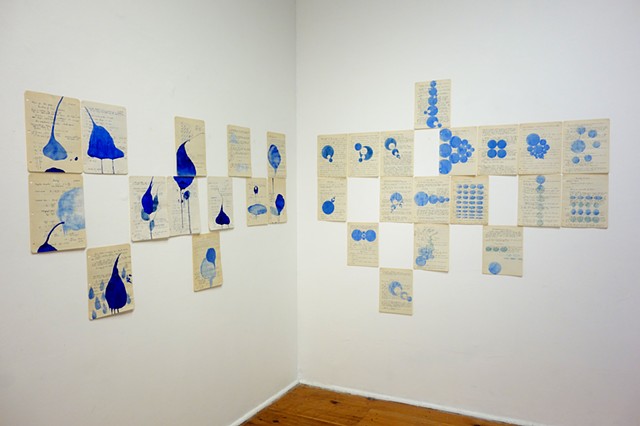
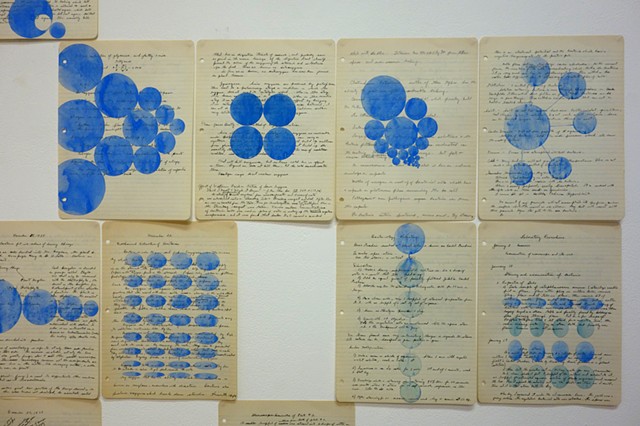
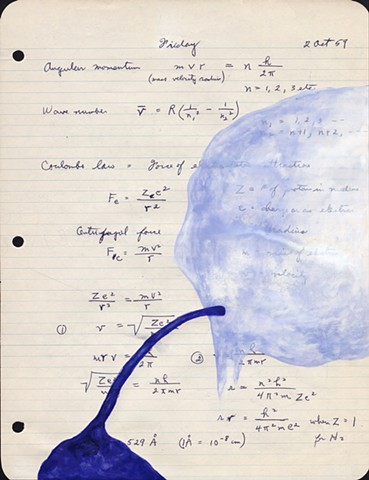
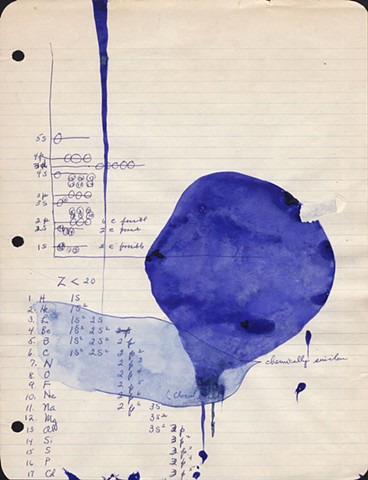
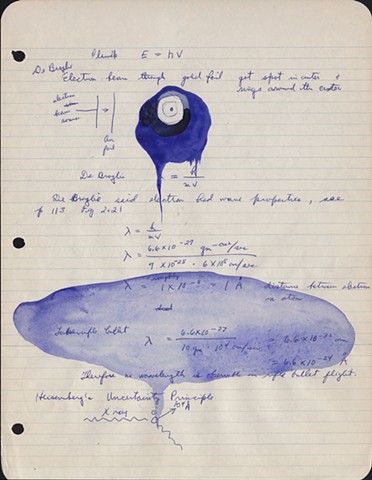
How to divide water series began probably a couple of decades ago. It began with my fascination for the property of water which can take different forms—liquid, solid, and vapor. The idea of “dividing” water was interesting to me then. It is difficult to divide water unless it’s a solid form or in a vessel, though technically you could split water into oxygen and hydrogen, known as water splitting. But “dividing” implies complex relationships and systems we built and conflicts that arise from dividing. Water has been divided and diverted throughout human history. Water is the most contentious element and reason for conflicts. Maybe this mindset is wrong all along. Water is not to be divided but to be shared.
The most recent series in How to divide water, III (2025–2026) explores data centers’ impacts on waters and energy use. Data centers, especially large scale centers called highperscale facilities require large amounts of water to operate. (Hyperscale data centers generally consume one to five million gallons per day, which is equivalent to the water use of a town of 10,000 to 50,000 residents.)1 With the rapid increases in global adoption of artificial intelligence (A.I.) in the recent years, more highperscale data centers are being built and many more are in planning stage, mostly in rural or working class communities. Draining massive amounts of water and using a lot of electricity, data centers pose severe threats to the environment and ecosystems, accelerating climate crisis on the global scale, and affecting physical and mental health of people in the regions.
There is another possible “drain” from the use of A.I. too—our cognitive development by offloading critical thinking to A.I. Many people are concerned about brain rot from using A.I., which is changing the way we think and do our work in an unprecedented way. The process of learning (for humans) is changing—being shortened and traded for efficiency and better products.
This work is created on old note pages filled with cursive handwritten notes taken for “Gas, oil, and fossil fuels” chapter in chemistry class by an unknown individual from the 1950s. The names of the top ten most companies with data centers are embedded in the drawings, using Climate Crisis font. Typed texts appear throughout the work to invoke the language used by or for A.I.
The typical question people ask for A.I. is “What does this mean and what should I do next?”
Climate Crisis:
Various shades of blue circles in my work do not represent geographical locations or exact numbers of data centers. Inside the clusters of circles are the white texts describing the names of the top 10 data centers in the world (as of February, 2026 data.) The font I used is called the |climate crisis font|https://kampanjat.hs.fi/climatefont|, developed by the Nordic’s largest newspaper Helsingin Sanomat. The font’s weight responds to NSIDC’s (National Snow and Ice Data Center) Arctic sea ice data from 1979 to 2019 and Intergovernmental Panel on Climate Change (IPCC)’s prediction all the way to 2050. The font I chose was the 2030 prediction, which is only four years away to meet the climate goals set in the Paris Agreement.
Reference:
Data Center and Water Consumption: https://www.eesi.org/articles/view/data-centers-and-water-consumption: Retrieved on June 26, 2026.