We are
We are
Site-specific installation:
Digital print on fabrics, synthetic fabrics dyed with plants, fabrics from Japan, wooden rods, and natural jute twine
MassQ Ball 2025: Color at the Arnold Arboretum of Harvard University, Jamaica Plain, MA. 2025
The Arnold Arboretum sits on land long inhabited by Indigenous Peoples, most recently the Massachusett Tribe, and on property purchased with wealth from goods produced by enslaved persons.
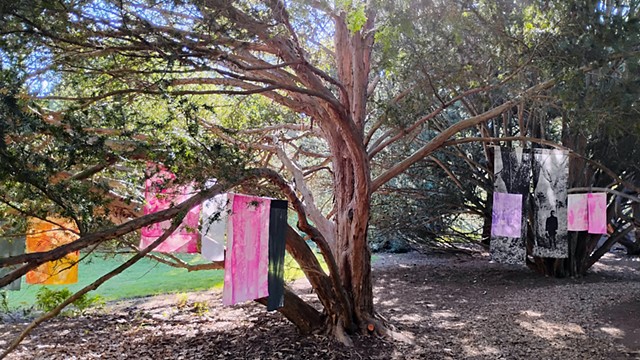
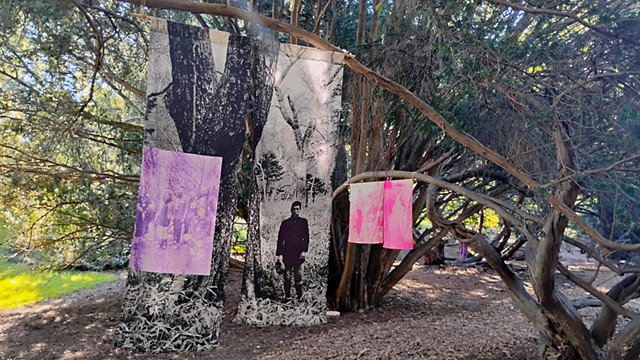
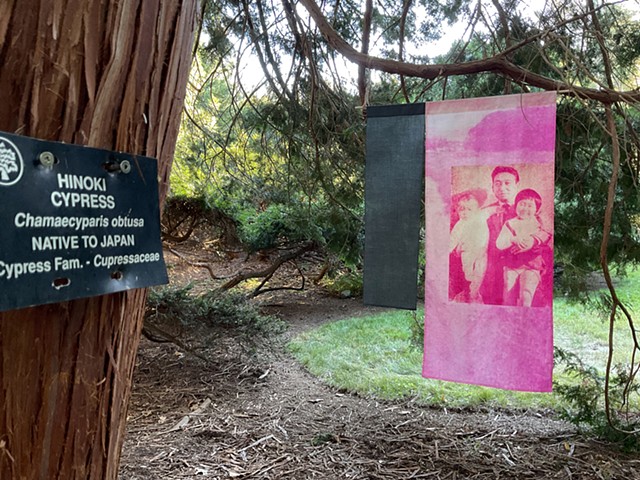
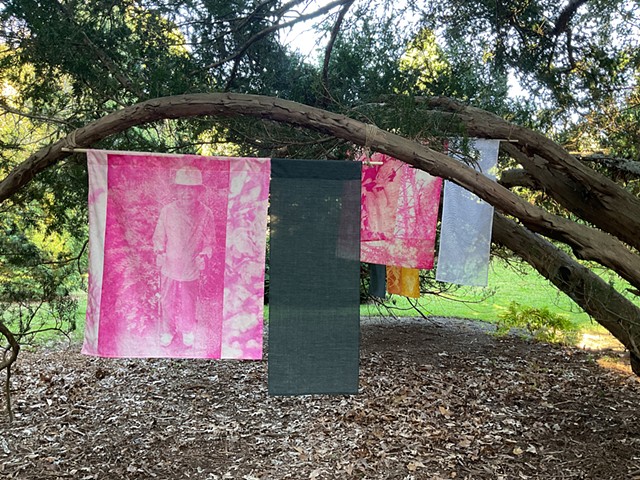
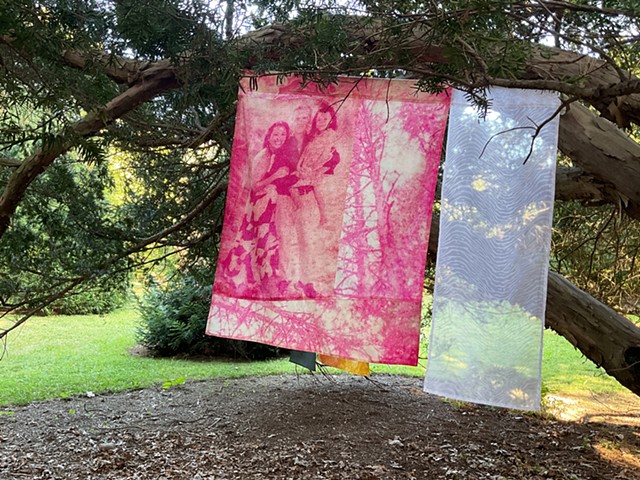
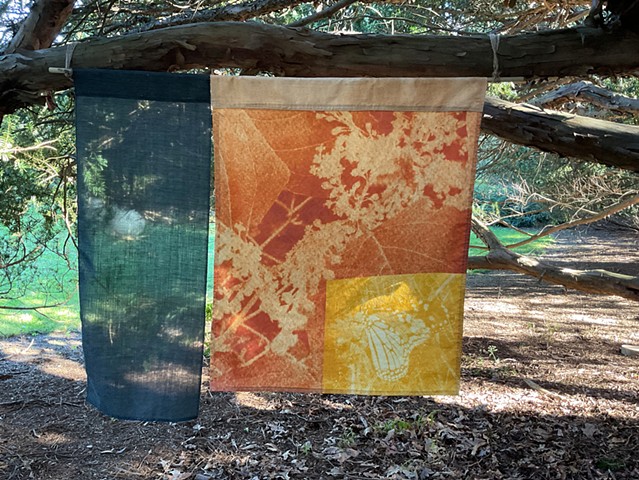
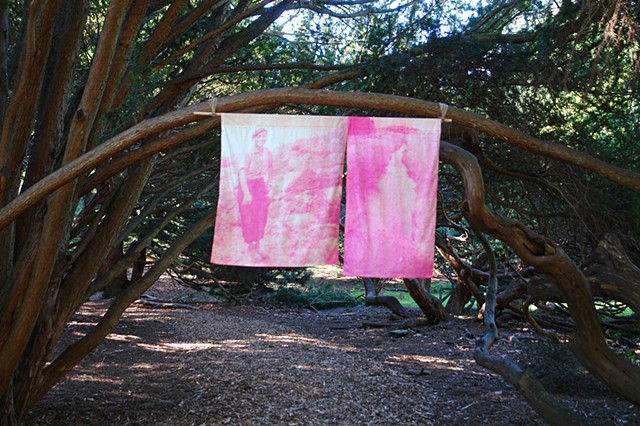
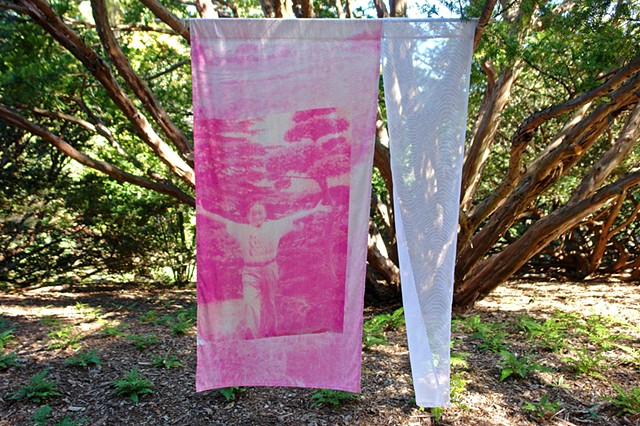
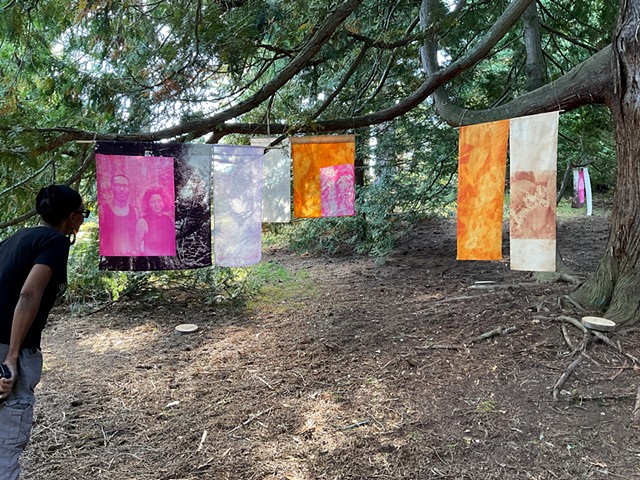
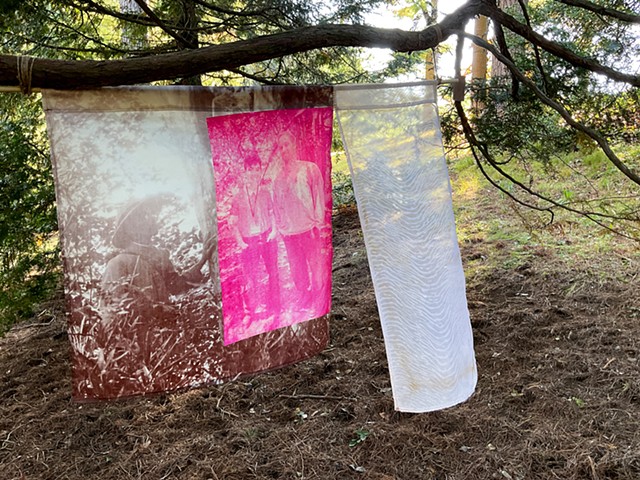
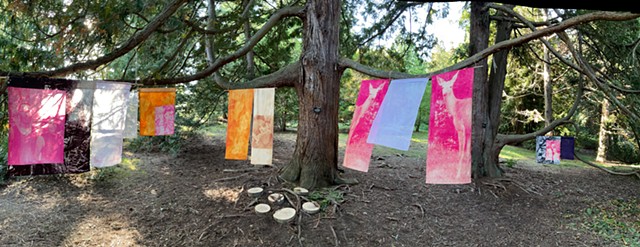
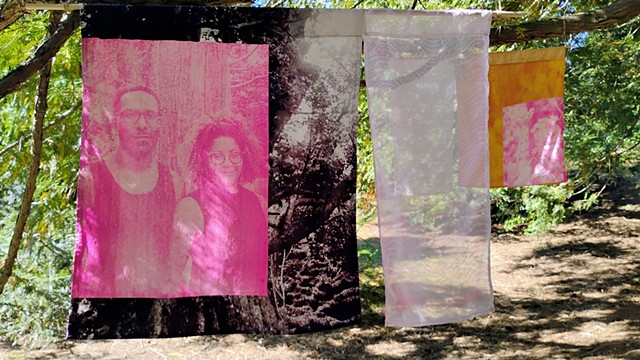
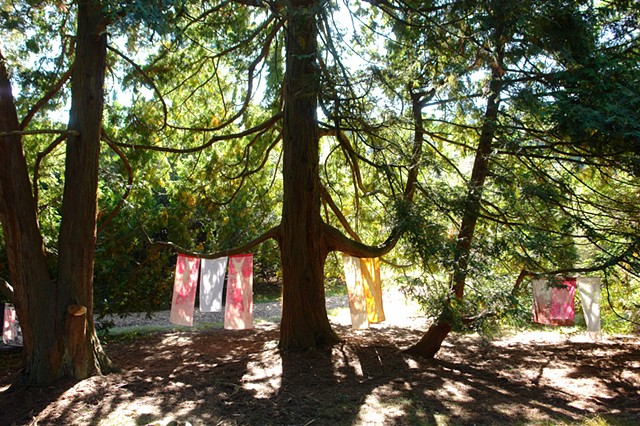
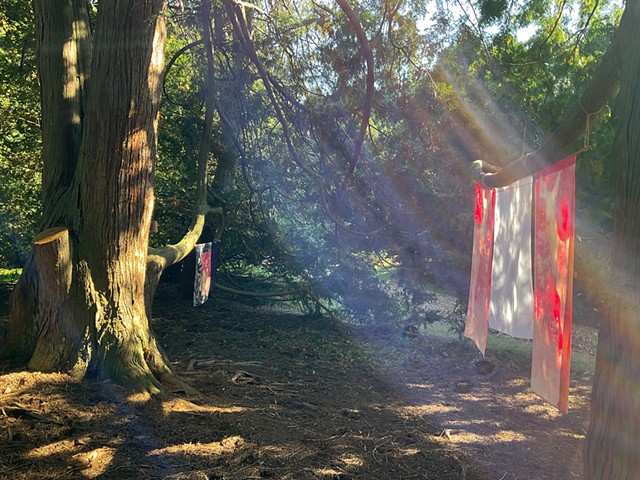
We are is an exploration on memory, history, migration, interconnected relationship with more than humans and intertwined human histories with them. Photographic images on fabrics interact with sun and wind in conversations, never still, moving and shifting shapes on this ancestral land.
Working with anthotype photography, an alternative method of photography that uses juice extracted from plants and exposed to sunlight, I created images for the fabric pieces.
First, I began with collecting plant materials and experimented with different types of plants including leaves and flowers from the Arboretum. Duration of the sun exposure depends on the intensity of sunlight and types of plant materials used as emulsion. There’s not much artistic control over the work except for deciding what plant to use and how it’s applied on paper, and when to remove from the sun exposure. I was left to nature’s will. Cloudy days meant not a good exposure and it would take more days or weeks, sometimes months to achieve good results. And there were many failures.
I needed the sun, just like the plants do, and I needed plants to do what I wanted them to do, except that plants do what plants do. The only thing I could do was to observe and learn. Learning to see the weather and plants in a different way, and to accept what nature has given me. A new rhythm of working outside the studio.
The collection of botanical and cultural images of Eastern Asia is in the Archives and Library of the Arnold Arboretum of Harvard University. Botanical expedition or often called plant hunting, goes as far back to the ancient times and the late 18th and 19th centuries witnessed its peak.
Plant explorers such as Ernest Henry Wilson (1876-1930), a British explorer and John George Jack (1861-1949), an American dendrologist, traveled to Eastern Asia to collect seeds and plants, but also took many photographs documenting plants, landscapes, and people. John George Jack spent a year in Japan, Korea, and northern China in 1905 and returned to Harvard with seeds and herbarium specimens representing 258 plants, along with 172 images of lantern slides. Wilson was responsible for introducing some 2,000 Asian plant species to the West. In these photographs in the collection (655 images for Japan under Ernest Henry Wilson alone in the visual archives,) I came across several striking images in which a person, often times man, is standing next to a tree. I assumed that it was to show the size of a tree. The image title always refers to the tree in its scientific name, such as “Acanthopanax ricinifolius Japan,” and the variant title lists “Tree trunk with man.”
I incorporated these archival images from the Archives and Library of the Arnold Arboretum along with my photographs including images from my family’s album, in particular, images of my late father who passed away earlier in 2025. It became a tribute to his life in this way, and also a celebration with more than humans—deer, butterfly, mushroom, bee, and Japanese knotweeds—among the majestic trees at the Arboretum.
I look up Japanese Hinoki trees in the Arboretum. I remember noticing its scent first before I knew it was Hinoki when I visited the area for the first time. I think of their journeys. I think of migration, passage, and time. I think of us—both transplants and growing roots. I think of a journey each one of us make on this earth, and how entangled we all are with each other and with more than humans.
The fabric pieces were inspired by noren, traditional Japanese fabric dividers often hung between rooms or in doorways. They allow easy passage through a long vertical slit(s) between pieces of fabric, while visually dividing a space into two separate spaces. Movement through it feels more fluid.
Honoring the passages and journeys made by ancestors including more than humans, We are celebrates and connects all lives on earth—past, present, and time ahead for the future generations.
We are was installed in a couple of different locations in the conifer section at the Arnold Arboretum; one in the Japanese Hinoki and Yew area and another in the Western Red Cedar area. My performance titled Carrying Roots took place in these areas and in between.
Special thanks to the co-producers of MassQ Ball, Ashleigh Gordon of Castle of Our Skin and Daniel Callahan for their invitation to be a part of MassQ Ball 2025, staff at the Arnold Arboretum, especially Sarah Nechamen, Manager of Adult Programming and Events, and horticulturalists team at the Arnold Arboretum for their support, and Lisa E. Pearson, Head of the Library and Archives at the Arnold Arboretum Horticultural Library for her help with high resolution digital files for the archival images.
Archival image references
Jack, John George. 1905. Cinnamomum Camphora Japan [Title from Recto of Mount.].
Arnold Arboretum Horticultural Library (Jamaica Plain) AAE-00098 (accession number)
Jack, John George. 1905. Stewartia Pseudocamellia Japan, Lake Chunzenji [Title from Recto of Mount.].
Arnold Arboretum Horticultural Library (Jamaica Plain) AAE-00179 (accession number)
Wilson, Ernest Henry. 1914. Betula Grossa Japan [Title from Recto of Mount.].
Arnold Arboretum Horticultural Library (Jamaica Plain) AAE-03396 (accession number)
Wilson, Ernest Henry. 1914. Cryptomeria Japonica Japan [Title from Recto of Mount.].
Arnold Arboretum Horticultural Library (Jamaica Plain) AAE-03168 (accession number)